Managing vs. Leading: Why the Difference Matters
There’s a difference between managing people and leading them.
And most of us learn it the hard way.
Managing keeps things running
Schedules get made.
Tasks get assigned.
Policies get followed.
Managing is about structure. It’s making sure the day-to-day works the way it’s supposed to.
And don’t get me wrong—that matters. A lot.
But managing alone isn’t what builds strong teams.
Leading is what makes people want to show up
Leading is different.
It’s the conversation you have when someone’s struggling—not just telling them what to fix, but helping them understand how to get better.
It’s setting expectations clearly, then actually supporting people in meeting them.
It’s noticing when someone’s off… and choosing to address it instead of hoping it fixes itself.
It’s being consistent, even when it’s uncomfortable.
It’s also the small things
Leadership isn’t always big moments or tough conversations.
Sometimes it’s as simple as paying attention.
Like seeing a sticker sheet at the store and immediately thinking of an employee who would love it—so you grab it for them.
It takes two seconds. It costs almost nothing.
But it tells your team: I see you. I know you. You matter here.
Those small moments build trust in a way policies and procedures never will.
Here’s the simplest way I think about it:
Managing focuses on tasks
Leading focuses on people
You can manage a team and still have high turnover, low morale, and constant frustration.
But when you lead well?
People take ownership.
They communicate better.
They stay.
The hard part
Leading takes more effort.
It requires patience.
Clarity.
And a willingness to have conversations most people avoid.
It’s easier to fix a schedule than it is to coach a person.
It’s easier to send a message than it is to sit down face-to-face.
But the long-term impact? Not even close.
A small shift to try:
Next time something goes wrong, pause before reacting.
Instead of:
“What needs to get done?”
Ask:
“What does this person need to be successful?”
That one question changes everything.
You don’t have to choose between managing and leading—you need both.
But if you’re only doing one, make sure it’s not just managing.
Because people don’t stay for systems.
They stay for leadership.
Communication at work: Keep it clear, keep it human.
Hi there,
If I had to pick one thing that causes the most tension, confusion, and inefficiency in the workplace, it wouldn’t be systems or staffing or even time…
It would be communication.
Or more accurately—lack of clear, consistent communication.
The good news? It’s also one of the easiest things to improve once you start paying attention to it.
💬 The most common breakdowns I see:
Assumptions instead of clarity
Conversations that happen too late (or not at all)
Feedback that’s vague or softened to the point of being confusing
Important information living in someone’s head instead of being shared
None of these come from bad intentions—they usually come from being busy, uncomfortable, or unsure how to say something.
🔑 4 Simple Ways to Improve Communication (Starting Now):
1. Say the thing (kindly, but clearly)
Clarity is kindness. You don’t need to over-explain or over-apologize—just be direct and respectful.
2. Don’t wait for the “perfect time”
Most conversations don’t get easier with delay. Address things early, before they build into bigger issues.
3. Confirm understanding
A quick “Does that make sense?” or “Can you repeat that back to me?” can prevent a lot of misalignment later.
4. Write it down
If it matters—document it. Processes, expectations, changes. It saves time, stress, and repeat conversations.
🧠 Did You Know?
Teams with strong communication practices are more productive, more engaged, and experience significantly less turnover.
Clear communication isn’t just a “soft skill”—it’s a business advantage.
✨ A small shift to try this week:
Before your next conversation, ask yourself:
“What is the clearest way I can say this?”
Not the nicest. Not the most polished. Just the clearest.
At Firth Consulting, a lot of the work I do comes back to this—helping teams communicate in a way that actually works. Clear expectations, better feedback, stronger alignment.
Because when communication improves, everything else gets easier.
If this is something your team struggles with, I’d love to help.
You can always reach out or book a time to chat here: [Insert Link]
– Sarah
Firth Consulting
P.S.
If you’ve ever left a conversation thinking “that could have gone better”… you’re not alone. That’s usually where the best improvements start.
A Small Pause…
Lately, I’ve been taking things a little slower.
Not in a big, noticeable way—just small shifts. A little more awareness, a little more intention, a little more space where I can.
From the outside, everything is steady. Work is moving forward, life is full, and there’s a lot to be grateful for.
But I’ve been reminded recently that it’s important to pause. It is important to take care of yourself.
Making space where you can
It’s easy to move quickly through life—onto the next task, the next goal, the next plan.
But every once in a while, it feels right to slow things down just enough to check in. To notice how things are feeling. To give yourself a moment to reset.
Not because anything is wrong—
just because it’s part of staying grounded.
What that looks like for me
For me, it’s been simple things.
Taking a little more time in the mornings.
Letting myself step away when I need to.
Trying to be a bit more present in the in-between moments.
Nothing dramatic—just small adjustments that make things feel a little more balanced.
A gentle reminder
You don’t always need a big reason to take care of yourself.
Sometimes it’s enough to recognize that a slower pace, even briefly, can help you show up better in everything else.
Why I’m sharing this
Because it’s easy to forget.
To get caught up in everything we have to do and overlook what might help us feel a little more steady along the way.
So if you’ve been moving quickly lately, consider this your reminder:
It’s okay to pause.
It’s okay to take a breath.
It’s okay to give yourself a little space.
Thirty-One
I turned 31 a couple months ago.
There’s something quieter about 31 than the birthdays that come before it. At 30, there’s the big milestone energy, the pressure to have it “figured out,” and at least one person shouting “dirty thirty!” with a tequila shot in hand. But 31? It just is.
And I kind of love that.
Thirty-one feels like sitting down in the life you’ve been building—looking around at the mix of chaos and calm, and thinking, okay, this is mine. The goals are still there, of course. The to-do lists, the stretch plans, the bigger dreams. But there's also a little more room for grace. A little more acceptance. A little more knowing—what I want, what I’ll walk away from, and where I’m still figuring it out.
This year, I’ve launched a business, worked long hours, said no more often, cried in the car more than once, had hard conversations, taken real rest, and celebrated wins that I would’ve missed in my twenties because I was too focused on what wasn’t done yet.
I still forget to drink enough water.
I still spiral about dumb stuff at night.
I still try to be everything to everyone sometimes.
But I’m learning.
I’m growing.
And I’m doing it in a way that feels real—not perfect, not always pretty, but true to me.
So here’s to 31.
To showing up.
To softness and strength.
To taking up space.
To continuing to build a life I’m proud of—on purpose.
The Power of Pausing: What Cross-Cultural Communication Teaches You
One of the most valuable things I’ve ever learned came from being completely unsure of what to say.
When I was 16, I lived in Chile for a 6 months as an exchange student. It was a crash course in more than just language—it was a crash course in humility, curiosity, and observation. My Spanish wasn’t fluent (especially not in “Chilean”), and I spent a lot of time listening, trying, stumbling, and trying again. That experience planted the seed for a lifelong fascination with language and culture.
Over the years, I studied and picked up English, Spanish, French, and Italian. Each one opened a new window into how people express themselves—what they value, how they connect, and what they leave unsaid. It also gave me a deep respect for how much of communication isn’t about the words at all.
Fast forward to my twenties, I lived and worked in Argentina. I was interning in Buenos Aires, helping bridge communication between nonprofits, small organizations, and government agencies (see the blog post about that here!). Even with solid Spanish, I still found myself often just a beat behind in conversations—learning to keep pace with local slang, tone, and nuance.
And in that space between knowing and not knowing, I learned how powerful it is to communicate with curiosity instead of certainty.
That lesson has stuck with me, and I’ve carried it into everything I do—especially in consulting.
Cross-cultural communication isn’t just about language. It’s about context. Assumptions. Body language. Power dynamics. Humor. Timing. What’s considered “efficient” in one culture might feel cold in another. What’s seen as “respectful” in one group might be overly formal or even off-putting in another. When we bring our full selves to work (which we should), we also bring our cultural frameworks—and they don’t always match.
So much of good consulting—and honestly, good leadership—is about noticing those differences and adjusting without judgment.
It means slowing down. Asking instead of assuming. Leaving space for someone to explain where they’re coming from. It means holding back the urge to immediately fix or streamline or reword—and instead listening closely for what’s being meant, not just what’s being said.
Cross-cultural communication taught me that clarity isn’t just about talking louder or simplifying language. It’s about creating mutual understanding, even when we start in different places.
And honestly? That kind of communication is better for everyone—no passport required.
What Argentina Taught Me About Listening, Language, and Conversation

Years ago, I packed a suitcase, boarded a plane, and moved to Buenos Aires, Argentina for an internship. I was in my early 20s, excited, unsure, and totally unprepared for how much that experience would shape how I work today.
The job? Consulting between nonprofits, small organizations, and government agencies—helping them align priorities, communicate needs, and find solutions in a system that was often under-resourced and overly complex. It was the kind of work that asked a lot of questions and offered very few easy answers.
I loved it.
Every day, I was working across languages—Spanish and English, sure, but also the unspoken languages of culture, power, and bureaucracy. I had to listen more than I talked. I had to ask better questions. I had to be okay not being the expert in the room.
That time in Argentina taught me that consulting isn’t about showing up with a fix. It’s about building trust, understanding different perspectives, and helping people find what’s already working—and build from there.
It also gave me a deep respect for the scrappiness of small organizations. The creativity. The resilience. The way people find a way forward even when the system isn’t designed to support them. That’s a lesson I carry into every project I touch, whether I’m working with a startup, a nonprofit, or a local business here in Oregon.
And of course, living in Argentina gave me all the other things, too: lifelong friends, empanadas that ruined me for all others, a love for long dinners and slow conversations, and a reminder that stepping outside your comfort zone is almost always worth it.
Sometimes the biggest lessons come from being a little lost, listening closely, and being willing to learn.
I didn’t just get consulting experience in Argentina—I got perspective.
And I bring it with me, every day.
Finally Football Season
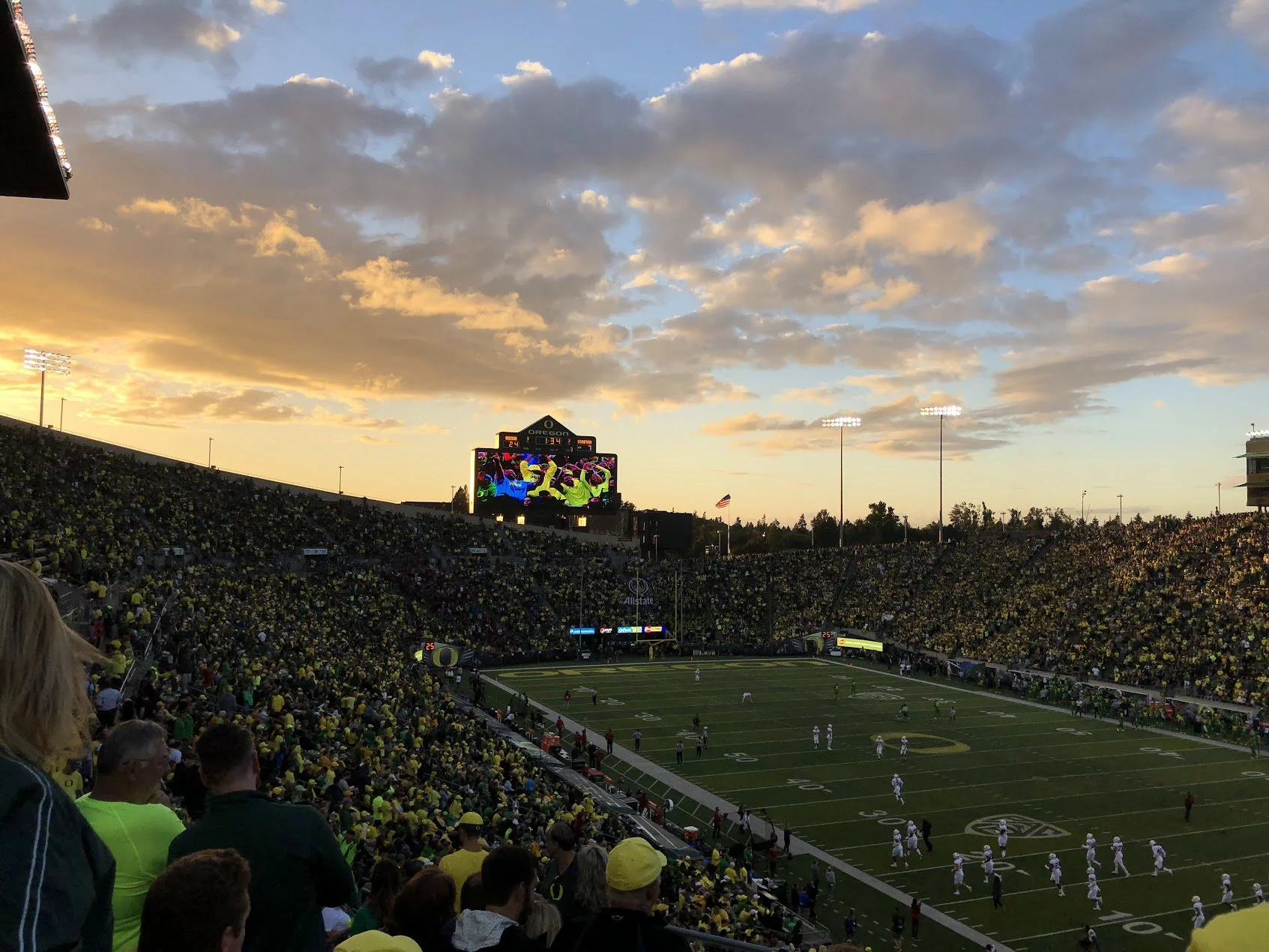
There’s something about the first crisp morning of late August that flips a switch in me. It’s not just the cooler air or the back-to-school buzz. It’s football season.
More specifically: it’s Ducks season.
Growing up in Oregon, I’ve been cheering for the Ducks for as long as I can remember. But it really clicked when I was a student at the University of Oregon. There’s nothing quite like walking to Autzen Stadium with a crowd of fellow students, face painted, voice already hoarse, and that buzz in the air that says, this is going to be a good one. Those memories are core to who I am—and honestly, they still get me fired up every fall.
Autzen on game day? Pure magic. The sea of green and yellow, the sound of “Shout!” echoing across the stands, the collective energy of people who care way too much about 3rd down conversions—it’s electric. It’s chaotic. It’s joyful.
And yes, I yell at the TV.
Yes, I have game-day rituals.
Yes, I believe in the power of a good tailgate and a clutch two-minute drill.
But I also see football as something more than just a sport. At its best, it’s about grit. Teamwork. Trust. Learning how to bounce back from a busted play or a tough loss. Watching college football reminds me that leadership isn't just about calling the shots—it’s about building something together, one hard-earned yard at a time.
It’s also one of the few times I really unplug. No consulting, no calendar, no work phone. Just snacks, friends, and four quarters of fully committing to something that doesn’t need to be productive—it just needs to be fun.
And speaking of fun—the first game of the season is this Saturday, and you better believe I’ll be watching. First games always feel like a fresh start. A little nervous energy. A lot of hope. And no matter what happens, I’ll be cheering loud.
So if you’re looking for me this weekend, you know where I’ll be: in green, yelling at a screen, fully committed to the chaos.
Go Ducks. Always.
More Than a Resume: Helping Someone Tell Their Story
Recently, I worked with a client on rewriting his resume.
He had years of solid experience, a strong work ethic, and a reputation for being the person everyone relied on. But his resume? It didn’t show any of that. It was short, generic, and undersold everything that made him great.
That’s a common thing I see—especially with folks who’ve spent years putting their heads down and getting the job done. They don’t always realize their story is worth telling. Or they just don’t know how to translate all that day-to-day work into language that lands with hiring managers.
So, we sat down and got to work. We talked about the roles he’s had, the problems he’s solved, the kind of teammate he is, and what he's proud of—even if it felt “small.” And then we built a resume that actually sounded like him. One that made it clear: this is someone you want on your team.
By the time we were done, he said, “I feel like this is the first time my experience actually looks good on paper.”
That’s the good stuff.
A resume isn’t just a list of tasks. It’s a snapshot of your value, your growth, and your voice. Helping someone shape that story is one of my favorite parts of what I do—because it’s not just about getting the job. It’s about remembering what you bring to the table.
Need help bringing your own resume to life? Let me know—I’d love to help you tell your story.
Top 5 Tips for Good Resume Writing
Lead with impact, not just duties.
Don’t just list what you were responsible for—share what you accomplished. Quantify when you can (increased sales by 20%, trained 15 new hires, cut costs by 10%).Tailor it to the job.
One-size-fits-all resumes rarely stand out. Use the job description to guide your language and focus. Show them you speak their language.Keep it clean and easy to read.
Use consistent formatting, clear section headings, and enough white space. A cluttered resume is an unread resume.Don’t sleep on the summary.
A strong 2–3 sentence summary at the top can set the tone. Use it to highlight your strengths and the kind of work you're looking for.Cut the fluff.
Phrases like “hard worker” or “team player” don’t mean much unless you back them up with real examples. Show it, don’t just say it.
Reminder to Let the Sun In
I haven’t written a blog post since since the end of June.
At first, I felt that little twinge of guilt. You know the one: You should be keeping up. You should be more consistent. You should be doing more.
But then I looked outside.
Summer has a way of asking us to slow down. The days stretch longer, the air gets heavier, and the world seems to collectively exhale—just a little. Lately, I’ve been trying to listen to that invitation.
It’s not always easy. I run a busy business, support others through Firth Consulting, and have a calendar that often fills faster than I’d like to admit. But I also know this: rest isn’t a reward for getting everything done. It’s part of the process.
Whether it’s an afternoon on the porch, a walk without your phone, a full day off (imagine that!), or just saying no to one more meeting—these moments matter. They make space for clarity. They allow creativity to stretch its legs. And they remind us that we are human beings, not just human doings.
So no, I haven’t written a blog post in a few weeks.
But I’ve had good conversations, caught up with friends, taken in some sun, and remembered why I care about balance in the first place.
If you need a sign to slow down, consider this it.
Take the break. Let the sun in. Everything else will still be there when you're ready to return.

What Consulting Actually Looks Like
When people hear the word consultant, they often imagine someone in a suit, delivering a slideshow full of buzzwords, and then disappearing just in time for the real work to begin.
That’s not me.
Firth Consulting was never meant to be about coming in with all the answers. It’s about listening, noticing, asking good questions, and helping people take the next step—even if they’re not exactly sure what the next step is yet.
Sometimes consulting looks like mapping out a full-blown marketing strategy. Other times, it’s helping someone write an email they’ve been avoiding for weeks. It might mean auditing their operations systems, or just standing next to them while they sort through what’s working and what’s not. It’s thoughtful. It’s collaborative. And most of all, it’s human.
What I’ve found is that most people aren’t looking for a guru—they just want someone to help them cut through the noise. Someone who can say, “Hey, here’s what I see. Want to figure it out together?”
That’s what I love doing.
Whether I’m supporting a small business, helping a nonprofit team get their footing, or partnering with someone who’s been wearing every hat for too long, the work always starts in the same place: connection. From there, we build systems, solve problems, and move forward—one intentional step at a time.
So no, I don’t have a slideshow.
But I do have a lot of heart, a sharp eye for detail, and a genuine love for helping people get unstuck.
And honestly? That feels like exactly the kind of consultant I want to be.
Managing Through the Madness: Lines, Call-Outs, and Keeping It Together
There are certain times of year in this industry that feel like trying to run a marathon... while also juggling... in a thunderstorm.
For us, that time is now.
Eugene Beer Week rolls into Father’s Day and graduation weekend, and together, they make up some of the busiest days of the year. We’re talking about back-to-back events, full taproom buyouts, collaboration beer releases, and a line out the door that doesn’t let up for hours. It’s exciting, it’s high-energy, and it can also push every system—and every person on the team—to the edge.
And here’s the part they don’t always tell you: someone will call out. Equipment will break. Something will run out. The day will not go as planned.
Still, the show must go on.
As a manager, you don’t get to tap out during the hard parts. You have to stay calm when it’s chaotic. You have to triage on the fly, support your staff, and keep the energy from turning toxic when the pressure is high. You have to be the steady voice when someone's overwhelmed, the backup dishwasher if needed, and the person reminding everyone to drink water and eat something.
What I’ve learned over the years is that the logistics matter, but the people matter more. Yes, we need prep lists, floor charts, and product counts—but we also need to check in with the bartender who’s been on their feet for six hours, give space for the kitchen to vent when the printer won’t stop, and make time to say thank you even in the middle of the storm.
Keeping morale high during high-volume stretches isn’t about perfection. It’s about presence. Being available. Being honest. Having their back.
And when the last shift ends and the doors finally close, we take a breath, raise a glass, and remember why we do it. Not just for the business—but for the team that shows up, every single day, and makes it happen.
Beer Week, Back-to-Back Events, and Why I Secretly Love the Chaos
Every June, something wild and wonderful happens in Eugene: Beer Week.
For seven days, breweries, bars, and beer lovers come together to celebrate craft beer culture in all its hoppy, hazy, and barrel-aged glory. As someone who sits on the committee helping organize the week across the city and runs a business that hosts six of its own events during that stretch… let’s just say I have a front-row seat to the madness.
And I kind of love it.
Planning Beer Week feels a little like conducting a very enthusiastic orchestra. You’ve got different players (each brewery, bar, and bottle shop), different styles (IPA tastings, sour showcases, collab launches, brewery bingo), and a whole lot of moving parts. The committee works hard to make sure the events are diverse, fun, and well-coordinated—and it’s incredibly rewarding to see our city come alive with beer lovers from all over.
Meanwhile, back at my day job, it’s full steam ahead. The business I help run puts on six days of events throughout the week. Each one requires its own lineup, promo, staff coordination, vendor communication, and vibe. It’s exciting, exhausting, and one of the best ways to connect with our community. But it doesn't stop there…
Just as Beer Week wraps up, we head straight into Father’s Day and graduation weekend—two of the busiest, most high-volume days of the year for our taproom. There’s no pause button. No reset day. Just deep breath… and go again.
It’s a marathon with a lot of sprinting built in.
And yet—despite the long hours, the constant prep, the endless kegs and event flyers—I genuinely love this time of year. It’s when creativity meets logistics, when collaboration meets community, and when we get to throw some of the most memorable events of the year.
Eugene Beer Week reminds me why I do this: because bringing people together around something they’re passionate about is always worth the work.
Even if I do sleep for a week afterward.
No Summer Break, No Problem (Mostly)
The beginning of June has a very specific energy in my family.
My dad was a college professor. My mom spent her career as a principal and administrator. Both of my sisters are teachers. So when June rolls around, there's a shift. The group texts get livelier. Someone inevitably sends a photo of a margarita. Words like freedom and nap and vacation countdown start flying around.
It’s summer break season, and for them, it’s sacred.
I didn’t go into education like the rest of my family, though I grew up surrounded by lesson plans, school schedules, and a deep belief in the power of learning. Instead, I ended up in operations and consulting—fields where there is definitely no “last day of school.” The work doesn’t slow down in June. In some ways, it ramps up. There are events to plan, projects to launch, systems to reevaluate. The calendar keeps going.
And honestly? I kind of love it.
Don’t get me wrong—I wouldn’t say no to an eight-week sabbatical and a beach chair—but there’s something fulfilling about this rhythm. I like the way my work moves with the seasons of real life, not the academic calendar. I get to help people build momentum during the quieter months, prepare for busy seasons, and carve out space for their own versions of “summer break,” even if it’s just an afternoon off that actually feels restorative.
Plus, I still get to channel that teacher energy. Explaining a new system, walking someone through a process, or helping a client see a path forward—it’s not so different from standing in front of a classroom. I just traded chalkboards for spreadsheets, and report cards for project timelines.
So no, I don’t get a summer break. But I do get something else: the chance to keep learning, keep building, and keep helping others do the same—all year long.
And if I’m being honest, I still text back with a margarita emoji anyway.
Business, Like Rafting, Is All About Reading the Water

I grew up in a raft.
Okay, maybe not literally, but some of my best memories are of early mornings loading coolers and gear into inflatable boats, life jackets still damp from the day before, and my parents—Jim and Lynda—double-checking straps and scouting rapids alongside a crew of family friends. We floated some of the most beautiful rivers in the Pacific Northwest, learning how to read the water, trust each other, and paddle like hell when it mattered.
That rhythm—the ebb and flow between calm stretches and white-knuckle rapids—feels a lot like running a business.
Outside of Firth Consulting, I manage a high-volume bottle shop and taproom with nearly 60 employees, dozens of vendors, a packed events calendar, and the daily dance of customers, coworkers, and kegs. Some days feel like a lazy river. Everything clicks. The team is in sync. The systems work. Other days? It’s class IV rapids and we’re bailing water while shouting directions over the roar.
Here’s the thing: both are normal.
Business, like rafting, isn’t about avoiding the rapids—it’s about being ready for them. It’s about building strong systems (aka paddling in sync), knowing when to pull off and regroup, and having the humility to admit when you're off-course.
Some days at work feel like a peaceful float—steady current, good rhythm, easy adjustments. Other days, it's full-on whitewater: surprises, tough calls, and the need to act fast without flipping the boat.
Rafting taught me that both conditions are part of the ride. You can’t always see what’s around the next bend, but you can learn to respond with a clear head. You figure out how to trust your crew, adapt in real time, and keep your footing—whether you're drifting or digging in with everything you've got.
Running a business is really no different. It’s not about avoiding chaos. It’s about learning how to move through it with a sense of direction—and maybe even a little grace.
getting unstuck
There’s this moment I love—when someone says, “I’ve been meaning to do this forever,” and then we actually do it. Whether it’s launching a website, getting their first real social media post up, or finally creating a system that makes their day run smoother, that moment is electric. You can see the relief in their shoulders, the spark in their eyes. It’s like they’re finally breathing again.
That moment is why I started consulting.
I’ve always been a problem-solver, someone who likes jumping into the middle of a mess and finding a path forward. But it’s more than checking things off a list. It’s about helping people feel confident and clear about what they’re doing—and excited again. Because let’s be real: running a business, managing a team, or even just keeping up with your creative projects can get really overwhelming.
Sometimes you don’t need a five-year plan. Sometimes you just need someone to say, “Here’s what we’re going to do next.”
At Firth Consulting, that’s what I try to bring to the table: calm in the chaos. Whether I’m helping with marketing, operations, or big-picture strategy, my goal is always the same—help people get unstuck and moving again.
It’s not flashy work. It’s not always glamorous. But it’s honest. It’s collaborative. And it’s deeply fulfilling.
So if you’ve been meaning to get your systems together, finally update your branding, or figure out how to get your business back on track—let’s talk. You don’t have to do it all alone.
I’d love to help you find that spark again.
From Roommate Photo Shoots to Running Campaigns: My Social Media Journey

Long before I ever thought about hashtags or engagement rates, I was running around with a camera and a college roommate named Greg. Back then, we weren’t trying to “build a brand” or “create content.” We were just two students chasing light, trying out ideas, and letting creativity take the lead. Greg, who is now an incredible designer, had the kind of eye that made everything feel intentional. I had the curiosity (and sometimes the chaos) to just try things and see what happened. (See his awesome work here!)
Looking back, that’s where it really started for me—with freedom, experimentation, and the fun of making things with someone else.
After college, I found myself working in the nonprofit world. Like many people in mission-driven organizations, I wore about twelve hats at once. One of those hats? Social media. I didn’t exactly know what I was doing at first, but I knew we had a great story to tell—and I wanted people to see it. So I started learning. A lot.
What I quickly found was that social media is a constantly moving target. Algorithms change, trends evolve, and what grabs people’s attention one week might flop the next. But I also found something else: the challenge of keeping up was part of the fun. Creating content that actually connects with people—whether it’s heartfelt, helpful, or just funny—is deeply rewarding. When you see something resonate, when a post sparks a conversation or drives someone to take action, you realize it’s not just noise. It can be real connection.
Since those early days, I’ve worked on everything from nonprofit campaigns to restaurant menu launches to professional branding. I’ve coached teams, built strategies, and managed a variety of accounts. And I still love it.
These days, social media can feel overwhelming—and sometimes downright exhausting. But it can also be a powerful tool for telling your story, reaching your people, and staying true to who you are. That’s the part I care about. That’s what I help others do.
And it all started with a camera, a friend, and the simple joy of creating.
Why I Started Firth Consulting (Again)
Somewhere deep in my earliest memories is the sound of a suitcase zipping shut. My parents, Jim and Lynda Firth, were often on the move—boarding planes, chasing ideas, and building relationships with people who were passionate about their work. My parents ran a small but mighty consulting business back then—Firth Consulting—and together they traveled the world during their free time, sharing knowledge and learning just as much in return.
In the early 2000s, everything changed when my dad had a stroke. The traveling stopped. The business paused. But the spirit behind it—the belief in collaboration, curiosity, and lifting others up—never went away.
This year, I decided it was time to carry that torch forward.
Firth Consulting is back.
This time with me at the helm.
I've spent years working in operations, HR, marketing, and leadership roles—mostly in the world of craft beer, restaurants, and nonprofits. I’ve seen firsthand how hard it is to juggle all the things when you're running a business, chasing a dream, or just trying to get an idea off the ground. And I’ve found that what I enjoy most is helping people sort through the mess, clarify their direction, and build something that works.
So that’s what I’m here to do.
Whether it's streamlining your workflow, planning your next big event, creating social media that actually sounds like you, or just being the person who asks the right questions—I’m here to help.
There’s something really full-circle about using the same name my dad did. It’s a quiet nod to the values he and my mom instilled in me: curiosity, humility, laughter, and a genuine desire to be of service. I hope to bring those same values to every project I take on.
Thanks for being here at the start. I’m excited to see where this goes—and if I can help you along the way, let’s talk.
– Sarah Firth